
Summary:
Motor control centers and panelboards both manage electrical circuits, but they serve very different jobs on a job site. A panelboard routes power to branch circuits for lighting, outlets, and small loads. A motor control center groups starters, breakers, and protection gear for multiple motors in one assembly. Knowing which one a facility needs prevents costly wiring mistakes and downtime.
An electrical room full of gray metal boxes can look the same to an untrained eye, yet two very different pieces of equipment sit side by side inside it. One handles a handful of household circuits without much fuss. The other manages a whole floor of motors running around the clock, each one needing its own point of access.
Mixing up the two on a project plan can mean ordering equipment that cannot do the job it was bought for. This guide explains what separates a motor control center from a standard panelboard in industrial electrical equipment and why the difference matters on a real job site.
What a Panel Board Actually Does
A panelboard takes incoming power and splits it into smaller branch circuits throughout a building. Circuit breakers sit inside the panel, each one protecting a specific circuit that feeds outlets, lights, or small appliances.
How Power Moves Through the Panel
Main power enters the panelboard through a large breaker or main lug, then splits across a bus bar. Each branch breaker taps into that bus bar and sends power to its own dedicated circuit, keeping every load separated from the others.
The Amperage Range Panelboards Cover
Panel boards are generally built for loads up to 1,200 amps. Most residential and light commercial panels operate well within this capacity, handling the electrical demands of standard lighting, outlets, and small equipment.
Where You Typically Find Them
Homes, offices, retail spaces, and small commercial buildings almost always use panel boards. They fit cleanly into a wall cavity or surface-mounted enclosure, and their compact size makes them practical for spaces without a dedicated electrical room.
Why Simplicity Is the Point
A panel board is not built to control complex equipment. It exists to protect wiring and distribute power safely to a wide range of small, independent loads. Its design stays simple on purpose, since the goal is reliable circuit protection, not motor management.
MCC Explained: What it Brings to an Industrial Setting
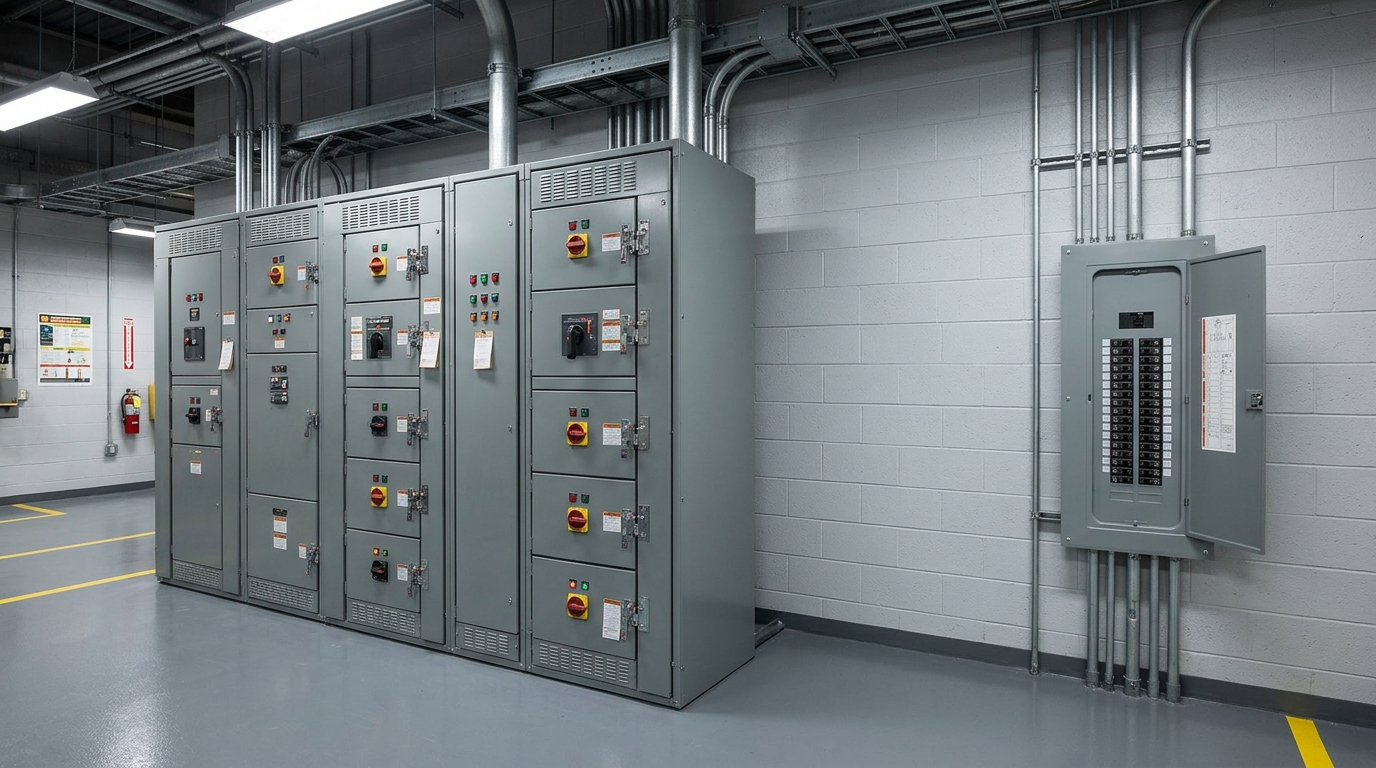
A motor control center groups multiple motor starters, breakers, and protective devices into one large, modular assembly. It manages the motors that run pumps, fans, conveyors, and other industrial equipment, not lights and outlets.
The Modular Bucket System
Each motor gets its own compartment inside the MCC, sometimes called a bucket. That compartment houses the starter, overload protection, and disconnect switch for a single motor, which lets a technician service one unit without shutting down the entire assembly.
Understanding Amperage and Scale
At its core, MCC is about understanding scale. These assemblies are rated for loads up to 3,000 amps, far beyond what a typical panelboard handles. That range fits the demands of factories, treatment plants, and other facilities running dozens of motors at once.
Built for Motors, Not General Circuits
Unlike a panelboard, an MCC includes components designed specifically for motor loads, such as thermal overload relays and, in some configurations, variable frequency drives. These features protect motors from overheating and allow speed control that a standard panelboard was never designed to handle.
Centralized Control in One Location
Grouping every motor starter into a single assembly gives operators one place to monitor, start, stop, and troubleshoot equipment. This setup reduces wiring runs across a facility and gives maintenance crews a clear starting point during a service call.
The Safety Advantage of Individual Buckets
Since individual MCC buckets can be isolated from the MCC bus, maintenance personnel can often service one motor circuit without shutting down the entire MCC. However, the appropriate lockout/tagout procedure, absence-of-voltage verification, and arc-flash safety requirements still apply.
Motor Control Center vs Panel Board: What Sets Them Apart
The table below lines up the two side by side across the factors that matter most when picking equipment for a project.
| Factor | Panel Board | Motor Control Center |
| Primary purpose | Distributes power to branch circuits | Controls and protects multiple motors |
| Typical amperage | Up to 1,200 amps | Up to 3,000 amps |
| Common setting | Homes, offices, small commercial spaces | Factories, plants, industrial facilities |
| Key components | Circuit breakers, bus bar | Starters, overload relays, disconnects |
| Serviceability | Shut down panel to work on a circuit | Isolate a single bucket without full shutdown |
| Complexity | Simple, standardized design | Modular, customized to motor load |
Choosing the Right Industrial Electrical Equipment for a Project
The right choice depends on what the facility actually needs to run. A building with lighting, outlets, and small office equipment has no use for a motor control center. A plant running compressors, pumps, and conveyor systems will quickly outgrow what a panelboard can safely handle.
Matching Equipment to Load Type
Panelboards work well when loads are small, independent, and spread across many separate circuits. Motor control centers make sense when several large motors need coordinated protection and centralized access in one place.
Planning for Facility Growth
A facility expecting to add more motor-driven equipment over time benefits from planning for an MCC early, since retrofitting a panelboard setup later gets expensive fast. Industrial buildings especially benefit from this kind of planning.
Working With a Qualified Supplier
The right specifications on the first order avoid costly returns and installation delays. A knowledgeable supplier can help confirm amperage needs, bucket configurations, and code requirements before equipment gets ordered.
Choosing the right equipment starts with a supplier who understands your facility’s load, future needs, and project requirements. EDC Electrical Distribution & Control helps customers identify the right electrical and motor-control equipment for their applications. Contact us today to discuss your project requirements and find equipment that fits your needs!
Quick Tips for Picking the Right One
A few practical checks can make the decision between a panelboard and a motor control center much easier before ordering any equipment.
- Count how many motors the facility actually runs. A single motor or two usually does not justify the cost of an MCC.
- Check the horsepower of each motor. Larger motors need the overload protection and starter options built into an MCC.
- Look at how loads are spread out. Scattered, independent loads point to a panelboard, while grouped motor loads point to an MCC.
- Think about future growth. Facilities planning to add equipment can save money by installing an MCC early and skipping a costly upgrade later.
- Ask about maintenance access. If technicians need to service one motor without shutting down others, an MCC’s individual buckets make that possible.
- Confirm the amperage rating needed. Loads above what a standard panelboard can safely handle call for a properly rated MCC.
Frequently Asked Questions
- Can A Panelboard Be Upgraded Into A Motor Control Center?
No. A panelboard and a motor control center use different internal designs and components, so one cannot simply be converted into the other. A facility that needs motor control capability will need to install a proper MCC.
- Do Motor Control Centers Need More Maintenance Than Panel Boards?
MCCs generally need more routine attention because they contain moving mechanical parts like starters and contactors. Panel boards mainly need periodic inspection of breaker connections and bus bar integrity.
- What Size Facility Typically Needs A Motor Control Center?
Facilities running several motors above five horsepower, such as manufacturing plants, water treatment facilities, and large HVAC systems, typically need an MCC rather than a standard panelboard.
- Is A Motor Control Center More Expensive Than A Panelboard?
Yes, motor control centers cost more upfront due to their modular construction and motor-specific components. That higher cost is offset by easier servicing and better protection for expensive motor equipment.
- What Size Facility Typically Needs a Motor Control Center?
There is no single facility size or motor horsepower threshold that determines when an MCC is required. MCCs are generally considered when a facility has multiple motors that need centralized starting, control, protection, and maintenance access. The final selection depends on the motor loads, control requirements, electrical design, available space, and future expansion plans.
Final Thoughts
Panelboards and motor control centers both keep electrical systems running safely, but they were built to solve different problems. A panelboard handles the everyday job of distributing power to small circuits, while an MCC takes on the heavier task of managing multiple motors in one coordinated assembly. Understanding the differences makes the motor control center vs. panelboarddebate much easier to settle and helps facilities choose equipment that supports safety, efficiency, and future growth.
Settling that debate is only half the job. If you are searching “electrical component shop near me,” EDC has the inventory and expertise to support whichever side you choose. Connect with us today for equipment that matches your decision!
