
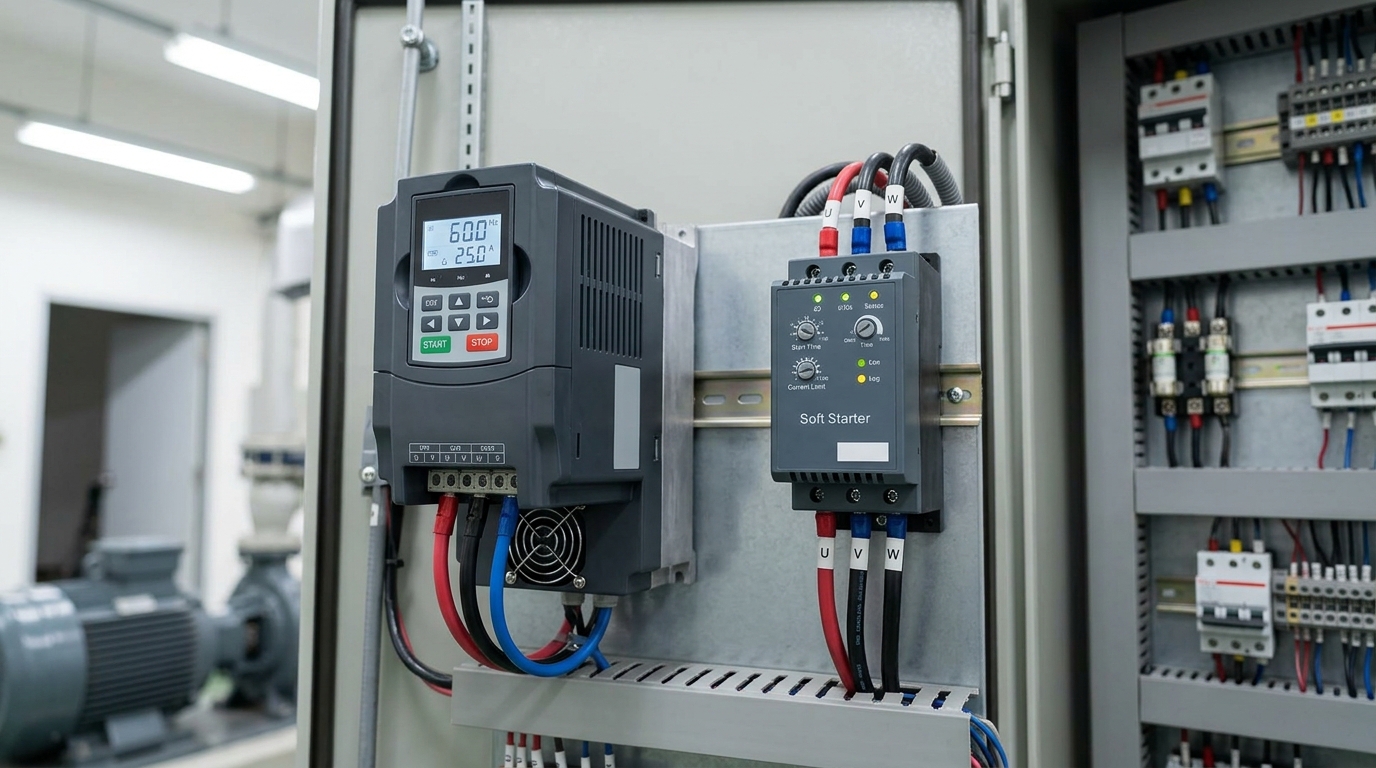
If you work with industrial motors, you have probably come across two terms more than once: Variable Frequency Drives and soft starters. This VFD vs soft starter industrial decision comes up constantly in motor-driven systems, and the stakes are higher than most people realize. Both devices handle motor control, but they are not the same thing. Picking the wrong one can cost you money, efficiency, or both.
This blog breaks down what each device does, how they differ, and how to decide which one fits your setup. No complicated jargon, just clear, practical information.
What Is a Soft Starter and How Does It Work?
A soft starter is a device that controls a motor’s startup. When a motor starts up at full voltage, it draws a large surge of current. That surge can stress the windings, jolt mechanical components, and create voltage dips that affect other equipment on the same line.
A soft starter solves this by gradually increasing the motor’s voltage during startup using components called thyristors. The motor ramps up smoothly instead of jerking to full speed all at once. Once it reaches full speed, the soft starter steps aside and lets the motor run normally at full line voltage. This gradual ramp-up is what keeps your motor control electrical parts safe from the wear and stress of sudden, full-power starts.
Soft starters are great for applications where the motor always runs at a fixed speed, and you need a gentler start. Here is where they work best:
- Pumps and compressors that run at a constant speed and only need protection from startup surges
- Conveyor belts with a consistent load that does not change during operation
- Fans in basic ventilation setups where airflow does not need to be adjusted
- Budget-sensitive projects where upfront cost matters and speed control is not a requirement
- Space-constrained panels, where a compact, simple device is a practical advantage
- Applications with infrequent starts, where the motor runs for long periods at full speed
What Is a Variable Frequency Drive and How Does It Work?
A variable-frequency drive supplier will tell you that a VFD does much more than just start a motor. It controls the motor’s speed continuously by adjusting both the voltage and the frequency of the power it delivers. This means the motor can run at any speed you need, not just full speed.
The VFD converts incoming AC power to DC, then inverts it back to AC at a controlled frequency. Changing that frequency directly controls how fast the motor spins. This gives you precise control throughout the entire operation, not just at startup.
VFDs shine in applications where the load changes and the motor speed needs to change with it. Here is where they deliver the most value:
- HVAC systems that need to adjust airflow or temperature based on real-time demand
- Water treatment plants where the pump flow must match varying pressure and volume requirements
- Food processing lines that require precise speed adjustments at different production stages
- Manufacturing equipment where variable torque and speed are part of the process
- Energy-intensive operations, where reducing motor speed during low-demand periods cuts costs significantly
- Automated systems that need integration with PLCs or process control software
VFD vs Soft Starter Industrial: The Core Differences
Here are the key differences that matter most in a real-world setting:
Speed Control
A soft starter has no speed control once the motor is running. It does its job at startup and then gets out of the way. A VFD, on the other hand, controls motor speed at every point during operation, including startup, running, and shutdown.
Energy Efficiency
This is where the two really separate. Soft starters do not save energy during normal operation since the motor runs at full line voltage after startup. VFDs are different because they can adjust motor speed to match demand, and even a modest reduction in speed can result in a dramatic drop in energy use for variable-load applications. The savings add up fast.
Cost
Upfront, soft starters are the more affordable option. A 50 HP soft starter might cost between $800 and $1,200, while a comparable VFD could run $2,000 to $3,500. However, VFDs often pay for themselves within 18 to 36 months through energy savings in the right applications.
Complexity
Soft starters are simpler devices with fewer components, which means easier installation and less maintenance. VFDs are more complex and may require some tuning and integration, but they offer far greater capability in return.
When Should You Choose a Soft Starter?
A soft starter makes sense when your motor runs at a constant speed and your main concern is reducing startup stress. It is the right call when the motor always runs at full speed once started and speed control is simply not part of the equation. If budget is a priority, a soft starter keeps costs down without sacrificing the protection your equipment needs.
It also works well when panel space is tight, since it is a more compact solution compared to a VFD. Applications like pumps, fans, and compressors with a consistent load are exactly the kind of setups where a soft starter does its job reliably and efficiently.
A soft starter gives you a cleaner, smoother startup without the added complexity or cost of a full drive system.
If your application checks those boxes, sourcing the right starter should be just as straightforward. EDC is a trusted name among electrical control distributors, stocking motor controls, starters, and hard-to-find electrical parts for industrial and commercial needs. Visit us to explore what we have in store for you.
When Should You Choose a VFD?
A VFD is the right tool when your process demands more than just a smooth start. If your motor speed needs to vary during operation, a VFD gives you that control in real time. It is also the better choice when long-term energy savings matter, since it actively reduces power consumption by matching motor output to actual demand.
Precise torque control at different speeds, integration with HVAC systems, water treatment setups, or any variable-demand process are all situations where a VFD earns its place. As an industrial electrical distribution supplier would confirm, matching the right drive to the right application is a core part of keeping industrial systems running efficiently and cost-effectively.
Real-World Applications: Which Fits Best?
It helps to look at specific use cases to understand the difference in practice.
Pumps
A pump that always runs at full speed and needs protection from startup surges is a great fit for a soft starter. A pump that needs to regulate flow based on demand, like in a water treatment facility, is a perfect candidate for a VFD.
Fans and HVAC
A basic exhaust fan running at constant speed? Soft starter works fine. A central air handling unit that needs to adjust airflow based on temperature demand? A VFD delivers the control and energy savings you need.
Conveyors
A conveyor that runs at one fixed speed can do well with a soft starter. A conveyor that needs speed adjustments for different production stages benefits from a VFD.
Total Cost of Ownership: Looking Beyond the Price Tag
It is easy to focus on upfront cost, but the smarter question is what this device will cost you over five or ten years. For fixed-speed applications, soft starters win on total cost. For variable-load applications, VFDs almost always come out ahead due to energy savings.
In real-world applications, fans running on VFDs have cut energy use noticeably and recovered the extra drive cost well ahead of expectations. That kind of return on investment is what makes VFDs the preferred choice in applications with fluctuating loads.
A Quick Reference: VFD vs. Soft Starter Side by Side
| Feature | Soft Starter | VFD |
| Speed Control | No | Yes |
| Energy Savings | Startup only | Continuous |
| Upfront Cost | Lower | Higher |
| Complexity | Simple | Moderate |
| Best For | Fixed-speed loads | Variable-speed loads |
| ROI Timeline | Immediate savings | 18–36 months |
Conclusion
Both VFDs and soft starters are valuable tools in industrial motor control. The right choice comes down to what your application actually needs. If you need a smooth start and your motor runs at constant speed, a soft starter is a practical, cost-effective solution. If you need continuous speed control, energy efficiency, and process flexibility, a VFD is worth the investment.
The most important step is understanding your load, your duty cycle, and your long-term energy costs before making a decision. Get those factors right, and you will choose the right device every time.
Getting the right parts into the right hands is what EDC does best. With a reputation built on quality and availability, we serve as a dependable Electric Control & Supply Inc. for industrial and commercial buyers who cannot afford downtime. Let’s get started!