
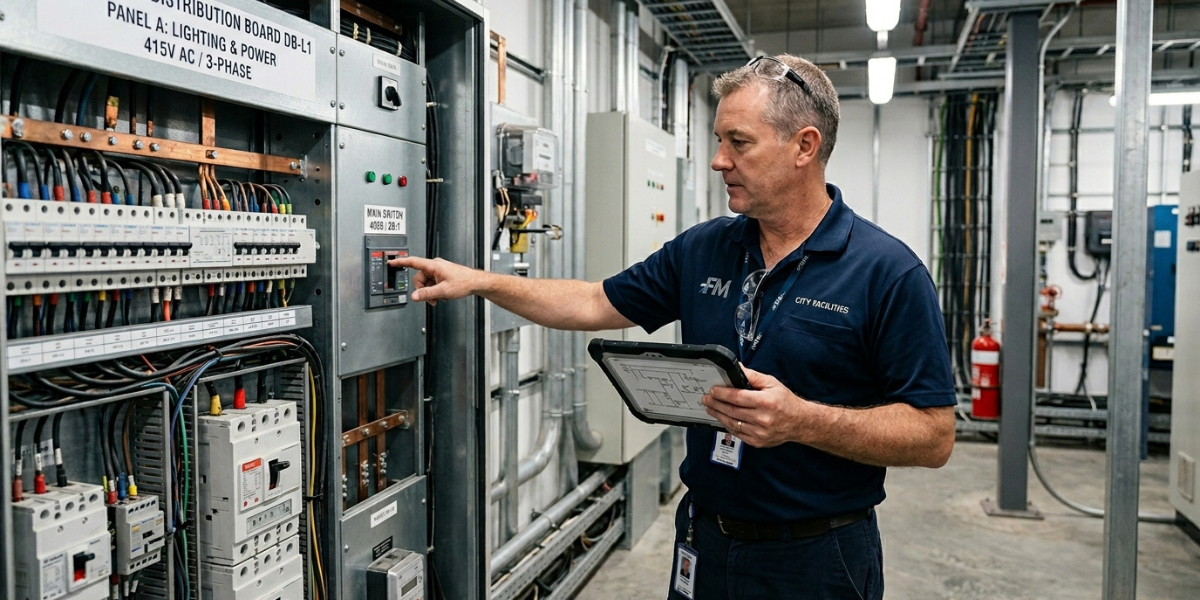
Managing a facility means overseeing systems that most occupants never think about, and the electrical distribution system sits at the top of that list. It is the infrastructure that takes power from the utility supply and delivers it reliably to every circuit, panel, and piece of equipment in the building. When it works well, nobody notices. When it does not, operations stop.
For facility managers stepping into the role, electrical distribution can feel like one of the more technical areas to get up to speed on. The terminology is dense, the components are numerous, and the consequences of mismanagement range from equipment failure to serious safety risk.
This electrical distribution system guide cuts through that complexity. It covers the core components of an electrical distribution system, how they work together, and what facility managers need to understand to oversee, maintain, and communicate about this infrastructure with confidence.
The Basics: What Is an Electrical Distribution System?
At its core, understanding the basics of an electrical system starts with a simple principle: electricity comes in from the utility, gets stepped down to usable voltage levels, and is then distributed to every piece of equipment, lighting circuit, and outlet in your facility.
The system consists of several layers working together. Electricity doesn’t just jump from a power station to your machines. It travels through a chain of components, each one playing a specific role in making sure the right amount of power reaches the right place safely.
Think of it as a well-organized supply chain. Power is the product, and the distribution system is the network that gets it where it needs to go.
Why Facility Managers Need to Understand This
You might be thinking, ” Isn’t this the electrician’s job? Technically, yes. But as a facility manager, you’re the one responsible for keeping operations running, managing budgets, coordinating maintenance, and making decisions when equipment fails.
Facility electrical management isn’t just about flipping breakers. It covers:
- Planning for equipment upgrades and new loads
- Coordinating with contractors during inspections or repairs
- Understanding what caused a power-related shutdown
- Evaluating when a system needs to be upgraded
- Keeping the facility compliant with safety standards
A basic understanding of your electrical system puts you in a much stronger position to do all of the above.
How Power Gets to Your Facility: The Journey Explained
Before getting into the components, it helps to understand the path electricity takes before it reaches your building.
- Generation: Electricity is produced at a power plant at very high voltages
- Transmission: High-voltage lines carry power over long distances
- Substation: Voltage is stepped down before entering populated areas
- Service Entry: Power arrives at your facility through a utility meter
- Main Distribution Panel: Power is received and sent throughout the building
- Sub-panels and Equipment: Power is distributed to individual circuits and machines
Each step reduces the voltage to a level that’s safe and usable for the next stage. By the time power reaches your outlets or machinery, it’s at a voltage your equipment can handle.
Key Components of a Commercial Electrical Distribution System
Getting a clear picture of the main components in a commercial electrical distribution setup is the best place to start. Here’s what each one does and why it matters.
Transformers
Transformers change voltage levels. They step high-voltage utility voltages down to levels safe for use inside the facility. Most commercial and industrial buildings have at least one transformer on-site or just outside.
Main Switchgear
This is the first major control point after power enters the building. Switchgear protects the system by isolating faults and controlling the flow of electricity to different parts of the facility. It also allows sections of the system to be shut down safely for maintenance.
Distribution Panels and Sub-Panels
These are the panels with circuit breakers that most people are familiar with. The main distribution panel receives power from the switchgear and sends it to sub-panels located throughout the facility. Each sub-panel serves a specific area or piece of equipment.
Circuit Breakers and Fuses
These are safety devices that cut power automatically when there’s an overload or short circuit. Without them, a fault could damage equipment or start a fire. They’re your system’s first line of defense.
Bus Bars
Bus bars are metal bars inside panels and switchgear that carry and distribute electrical current. They’re essentially the highways that power travels along before splitting off into individual circuits.
Cables and Wiring
All the components in the world mean nothing without the wiring connecting them. Cables must be properly sized for the loads they carry, and insulation must be in good condition to prevent faults.
Need reliable electrical products without the runaround? EDC stocks new and reconditioned components for commercial and industrial facilities. When you call us, you’re getting a team that knows electrical systems, not just a parts counter. Get in touch with us today, and we’ll help you find the right component and make sure it works for your specific application.
Industrial Power Distribution: What Makes It Different
It operates at a different scale and complexity compared to a standard commercial office building. Here’s a quick comparison to put it in perspective:
| Feature | Commercial Facility | Industrial Facility |
| Voltage Levels | Typically 120V / 208V / 480V | Can reach 4,160V or higher |
| Load Types | Lighting, HVAC, computers | Heavy motors, conveyors, machinery |
| Control Systems | Basic panels and breakers | MCCs, PLCs, VFDs |
| Redundancy | Limited | Often built-in for uptime |
| Maintenance Complexity | Moderate | High |
| Downtime Tolerance | Moderate | Very low |
Industrial facilities can’t afford unplanned downtime. Every minute a production line is down has a direct financial impact. That’s why industrial electrical systems are built with layers of protection and redundancy that commercial buildings often don’t need.
Common Electrical Distribution Configurations
Facilities use different system layouts depending on their size, budget, and reliability needs.
Radial System
The simplest layout. Power travels in a single direction, flowing from the source to the load. It’s cost-effective but offers no redundancy. If one section fails, everything downstream loses power.
Loop System
Power can flow in two directions around a loop. If one path is interrupted, power can still reach equipment via the other path. More reliable than a radial system.
Network System
Multiple sources feed into a shared network. Highly reliable and commonly used in hospitals, data centers, and large industrial plants where any downtime is unacceptable.
How to Manage Your Facility’s Electrical System Effectively
Good electrical management in a facility comes down to three things: knowing your system, maintaining it regularly, and acting quickly when something goes wrong.
Know Your Single-Line Diagram
A single-line diagram is a simplified map of your electrical system. It shows how power flows through your facility and where every major component sits. Every facility manager should have access to an up-to-date version of this document.
Schedule Regular Inspections
Electrical systems don’t last forever. Connections loosen over time, insulation degrades, and components wear out. Annual inspections by a licensed electrician can catch problems before they turn into emergencies.
Track Load Changes
Every time you add new equipment, you’re adding load to the system. If the system isn’t sized to handle the extra demand, you risk tripping breakers, overheating components, or worse. Always consult an electrician before making significant additions.
Keep Maintenance Records
Document every inspection, repair, and upgrade. This history is valuable when troubleshooting problems and essential when planning future upgrades.
Train Your Team
Your facility staff doesn’t need to be electricians, but they should know the basics. They should know where the main shutoff is, how to report an electrical issue, and what not to touch.
Signs Your Electrical Distribution System Needs Attention
Catching problems early saves money and prevents dangerous situations. Watch out for these warning signs:
- Frequently tripping circuit breakers
- Flickering or dimming lights
- Burning smells near panels or outlets
- Warm or discolored outlet covers
- Equipment running hotter than usual
- Unexplained spikes in energy bills
- Buzzing or humming sounds from panels
Any one of these should prompt a call to a qualified electrician. Don’t wait until the system fails.
Frequently Asked Questions
Q1: What is the main purpose of an electrical distribution system?
Its job is to take electricity from the utility supply and deliver it safely and reliably to every piece of equipment, lighting circuit, and outlet throughout the facility at the right voltage and current levels.
Q2: What is the difference between a main panel and a sub-panel?
The main panel receives power directly from the utility and distributes it throughout the building. Sub-panels are smaller panels fed by the main panel that serve specific areas or equipment sections within the facility.
Q3: How often should a commercial electrical system be inspected?
Most experts recommend a full inspection at least once a year. Older systems or facilities with heavy electrical loads may benefit from more frequent checks.
Q4: What causes circuit breakers to trip repeatedly?
Repeated tripping usually points to an overloaded circuit, a short circuit, or a ground fault. It can also indicate a failing breaker that needs to be replaced. A licensed electrician should assess the cause before repeatedly resetting the breaker.
Q5: How does industrial power distribution differ from commercial electrical systems?
Power distribution at the industrial level operates at higher voltages, handles heavier and more complex loads, and requires more sophisticated control systems. It’s also built with greater redundancy because unplanned downtime in an industrial setting carries significant financial consequences.
Conclusion
You don’t need to know how to wire a panel to be effective at facility electrical management. But understanding how your electrical distribution system maps out, what each component does, and how to spot early warning signs puts you in a far better position to protect your facility and the people in it. Start with the basics, build your knowledge over time, and lean on qualified professionals when the work goes beyond your scope. That’s smart facility management.
Got an electrical issue that needs more than a quick parts order? EDC’s service and repair team is happy to step in. We identify the right components, source what your system needs, and get your equipment back up and running. Reach out to us and put our expertise to work for your facility!