
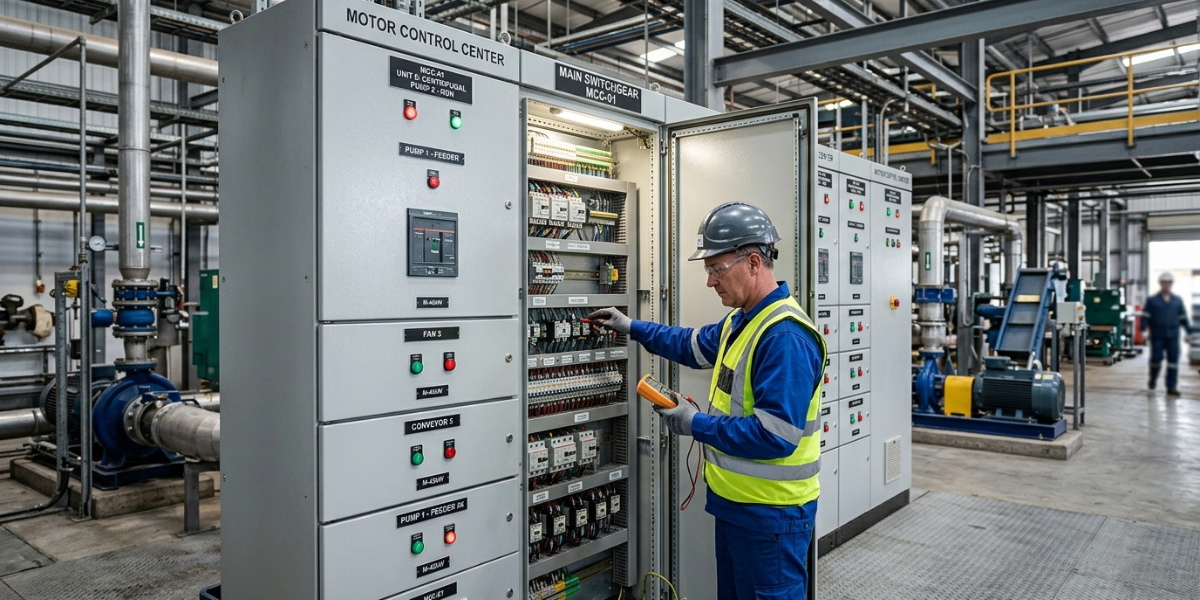
If you’ve ever walked through an industrial facility and spotted a large metal enclosure packed with switches, relays, and wiring, there’s a good chance you were looking at a Motor Control Center. Most people walk past them without giving them a second thought. But these systems are the backbone of some of the world’s most demanding industrial operations. So what exactly are they, and why do they matter so much?
This guide explores what a Motor Control Center is, covering how it works and why it plays such a critical role in industrial operations today. Let’s get started!
Motor Control Center Explained
A motor control center, commonly referred to as an MCC, is a centralized assembly of electrical components that manages, controls, and protects multiple electric motors from a single location. Rather than scattering individual motor starters and controls across a facility, an MCC brings them together into a single, organized, accessible unit.
Think of it as the command hub for all motor-driven equipment in a building or plant. Pumps, fans, compressors, and conveyors all rely on motors to run, and an MCC is what keeps them operating safely and efficiently.
Industries rely on them in manufacturing plants, water treatment facilities, oil and gas operations, power generation plants, HVAC systems, and mining environments. Anywhere multiple motors need to be monitored and controlled, an MCC is the standard solution.
How Is an MCC Structured?
Learning about the structure of an MCC helps clarify how it actually works in practice.
An MCC consists of enclosed metal sections, each containing a vertical bus bar that connects to a main horizontal power bus running the full length of the unit. Each vertical section holds individual motor control units, sometimes called “buckets”, that house the components responsible for starting, stopping, and protecting individual motors.
Key Components Inside an MCC
- Motor Starters: Control the starting and stopping of each motor
- Circuit Breakers or Fuses: Protect against overcurrent and short circuits
- Overload Relays: Detect and respond to excessive current draw
- Contactors: Electromechanical switches that open and close circuits
- Disconnect Switches: Allow safe isolation of individual units for maintenance
- Variable Frequency Drives (VFDs): Regulate motor speed based on load demand
- Push Buttons and Selector Switches: Provide manual control points
- Horizontal and Vertical Bus Bars: Distribute power throughout the MCC
Each component is rated based on voltage, current, frequency, and horsepower requirements. The modular design means individual units can be accessed, maintained, or replaced without taking the entire system offline.
If you need any component of your MCC replaced, EDC provides new and reconditioned motor control products. We also offer expert repair and installation support, so you don’t have to worry about your day-to-day operations shutting down.
Types and Configurations of MCC Electrical Systems
MCC electrical systems come in several configurations, and choosing the right one depends on the application, available space, and operational requirements.
| MCC Type | Description | Best For |
| Freestanding MCC | Floor-mounted, self-supporting enclosure | Most industrial applications |
| Wallmount MCC | Compact, mounted directly to a wall | Smaller facilities with limited floor space |
| Intelligent/Smart MCC | Integrated with digital communication protocols | Automated plants, remote monitoring |
| Arc-Resistant MCC | Built to contain arc flash incidents | High-risk environments |
| Outdoor MCC | Weatherproofed for exterior installation | Water treatment, oil, and gas sites |
What is the Importance of a Well-Maintained Industrial Motor Control?
Industrial motor control is about much more than just switching motors on and off. It’s about reliability, safety, energy efficiency, and uptime. Here’s why it carries so much weight in industrial settings.
Safety
MCCs minimize direct human contact with live electrical equipment. All high-voltage components are enclosed and organized, significantly reducing the risk of electrical accidents. Arc-resistant MCC designs take this further by containing the energy released during an arc-flash event, protecting nearby personnel.
Efficiency
When VFDs are added to an MCC, motors draw only the energy they actually need at any given time. This keeps energy consumption down across the facility, especially in equipment like pumps and fans that rarely run at full speed all day long.
Centralized Control
Having all motor controls in one place makes it dramatically easier to monitor system status, respond to faults, and carry out routine maintenance. Operators can see what’s running, what’s stopped, and what’s faulted, all from a single point.
Scalability
MCCs are modular by design. As a facility grows and adds new equipment, additional buckets or sections can be incorporated into the existing MCC without replacing the entire system.
Common Motor Control Methods Used in MCCs
- Direct-On-Line (DOL) Starters: The simplest method that connects the motor directly to the power
- Star-Delta Starters: Reduce startup current for larger motors
- Soft Starters: Gradually ramp up voltage to protect the motor during startup
- Variable Frequency Drives (VFDs): Offer precise speed control and significant energy savings
Common Causes of MCC Failures
Even the most robust systems can run into problems. Knowing what can go wrong helps with prevention.
- Loose connections or faulty wiring: Usually the result of improper installation or vibration over time
- Overheating: Caused by excessive load, poor ventilation, or component failure
- Moisture and corrosion: High humidity or condensation inside the enclosure damages components
- Mechanical wear: Contactors and relays have a finite number of operating cycles
- Environmental contamination: Dust, chemicals, and debris can interfere with sensitive components
Regular inspection and preventive maintenance are the most effective ways to keep MCC electrical systems running reliably. Continuous thermal monitoring using smart sensors is increasingly common in facilities that can’t afford downtime.
MCC vs Other Electrical Control Systems
It’s worth clarifying how an MCC differs from similar systems, since the terminology can get confusing.
| System | Primary Function |
| Motor Control Center (MCC) | Centralizes control and protection of multiple motors |
| Switchgear | Controls and protects high-voltage electrical distribution |
| Panelboard | Distributes power to lighting and general circuits |
| PLC (Programmable Logic Controller) | Issues commands and logic to control systems |
| VFD (Variable Frequency Drive) | Controls motor speed; can be housed inside an MCC |
An MCC and a PLC often work together. The PLC sends commands, and the MCC executes them. They’re complementary, not interchangeable.
Smart MCCs and Modern Integration
Modern electrical distribution motor control has moved well beyond simple on/off functionality. Today’s smart MCCs connect with programmable logic controllers (PLCs), human-machine interfaces (HMIs), and plant-wide networks, giving operators a clear, real-time picture of how every motor is performing. That includes current draw, temperature, run time, and fault history, all trackable without leaving the control room.
This level of integration supports predictive maintenance, enabling problems to be identified and addressed before they cause unplanned downtime. Instead of waiting for a motor to fail, the system flags early warning signs like rising temperatures or unusual current patterns.
Industries that deal with continuous operations, such as oil refineries, water treatment plants, and food processing facilities, benefit enormously from this capability. Every unplanned shutdown costs time and money, and smart MCCs help prevent them.
Frequently Asked Questions
Q1: What does MCC stand for in electrical systems?
MCC stands for Motor Control Center. It’s a centralized enclosure that houses components to control, protect, and monitor multiple electric motors in a single location.
Q2: Where are motor control centers typically used?
MCCs are widely used in manufacturing plants, water treatment facilities, oil and gas operations, power generation stations, mining environments, and large HVAC systems.
Q3: What is the difference between an MCC and a switchgear panel?
An MCC is designed specifically to control and protect electric motors, while switchgear handles higher-voltage electrical distribution and protection for broader power systems. They serve different functions within an electrical infrastructure.
Q4: How long does an MCC typically last?
With proper maintenance, an MCC can last 20 to 30 years. Components like contactors and overload relays may need to be replaced sooner, but the enclosure and bus structure can serve a facility for decades.
Q5: What is a smart MCC?
A smart MCC uses digital sensors and communication technology to monitor motor performance in real time, including energy use, temperature, and fault data. It moves electrical distribution motor control beyond basic switching, enabling early problem detection and remote management from a control room without being on the floor.
Conclusion
A Motor Control Center is one of the most important pieces of infrastructure in any facility that relies on electric motors. It keeps operations safe, organized, and efficient by centralizing control, making monitoring, maintenance, and troubleshooting far more manageable. As industrial operations grow more complex and automation becomes the norm, MCCs are evolving to meet those demands, with smarter integration, better protection, and greater flexibility than ever before. Getting to know how they work is the first step toward getting the most out of them.
If you need reliable MCC service and repair support, EDC is happy to help. Reach out today and let our experienced team take care of the rest!