
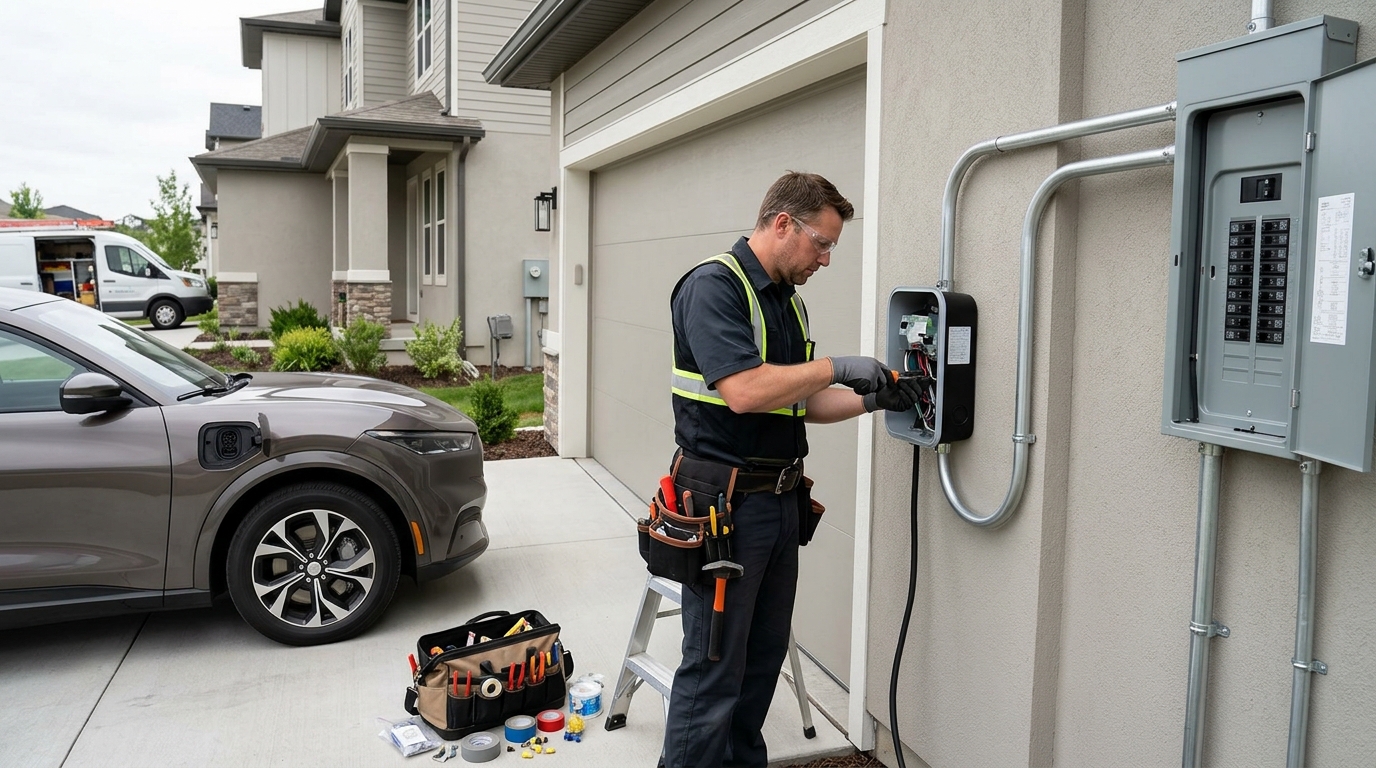
Summary:
Installing an EV charger at home requires more than choosing a charging unit. A Level 2 charger typically needs a properly sized 240-volt circuit, adequate panel capacity, suitable wiring, and compliance with local permit requirements. Charger amperage, installation distance, electrical upgrades, and labor can all affect the final cost, so understanding these factors before installation can help homeowners plan the project more effectively.
Installing an EV charger at home puts daily charging within reach, but the electrical work requires careful planning. The charger’s power rating, your home’s available electrical capacity, wiring requirements, and local permit rules all affect the installation.
Before choosing equipment, it helps to understand how EV charger installation works at home, whether an EV charger needs a dedicated circuit, and the Level 2 charger electrical requirements that apply. This guide also covers the cost to install a home EV charger, permit considerations, and the key steps involved in setting up a reliable home charging system.
Home charging: Level 1 and Level 2 options
Level 1 charging operates through a standard 120-volt household outlet and provides a slower charging rate. Level 2 charging uses a 208- to 240-volt supply and can deliver substantially more charging power. The appropriate option depends on your vehicle, driving habits, and available electrical capacity.
| Charging level | Voltage | Typical range added per hour | Circuit needed |
| Level 1 | 120 volts | About 5 miles | Standard household outlet |
| Level 2 (40 amp charger) | 240 volts | About 20 to 30 miles | Dedicated 240-volt circuit with a 50-amp breaker |
A Level 1 charger may be suitable when daily driving requirements are modest and charging time is not a concern. Level 2 charging is generally more practical for homeowners who want faster overnight charging and have the electrical capacity for the installation. Charging speed and range added per hour vary by vehicle and its onboard charging capability.
What Your Home Must Provide For A Level 2 Charger
Understanding the level 2 charger electrical requirements before purchasing equipment can help you avoid choosing a charger that exceeds your home’s available electrical capacity. The charger rating, breaker, conductors, installation method, and panel capacity all need to work together.
Voltage
Level 2 charging equipment commonly operates at 208 to 240 volts. A residential electrician can determine how to supply the required voltage from the home’s electrical panel and route the circuit to the charging location. You should also check the exact equipment requirements against the charger’s installation instructions.
Charger amperage
Common residential Level 2 chargers are available in ratings such as 32, 40, and 48 amps. Increasing the charger’s amperage can increase charging power, but it also requires a larger circuit and sufficient electrical capacity. Consider the vehicle’s own charging capability too, because it may not accept all the power a higher-rated charger can provide.
The continuous load rule
The NEC treats EV charging as a continuous load under the referenced NEC guidance. The circuit is generally sized at 125 percent of the charger’s maximum load. This means a 32-amp charger requires a 40-amp circuit, a 40-amp charger requires a 50-amp circuit, and a 48-amp charger requires a 60-amp circuit.
Wire and breaker selection
The required conductors depend on the charger’s electrical load, wiring method, installation conditions, and circuit requirements. Longer runs can also affect material and labor costs because the project may need more wire or conduit. Your electrician should select conductors and overcurrent protection that are appropriate for the specific charger and installation.
Panel capacity
Before installing a Level 2 charger, evaluate the home’s electrical capacity. A 40- or 48-amp charger can represent a substantial additional load, so you need to consider the available panel capacity before installation. In some cases, an energy management system or adjusted charger output can help manage available capacity. Other projects may require panel or service work.
Plug-in or hardwired
A plug-in charger can use a properly rated receptacle, such as a NEMA 14-50 configuration where the equipment and installation call for it. This arrangement limits many plug-in EVSE units to 40 amps. Hardwired equipment can support higher ratings when the charger is designed and listed for that installation. The choice affects wiring, installation requirements, flexibility, and project cost.
What Home Charger Projects Cost In 2026
The cost to install home EV charger equipment varies according to the charger, electrical work, wiring distance, permits, and the condition and capacity of the existing electrical system. Current 2026 guides place many straightforward Level 2 installations in the range of roughly $800 to $3,000, while another 2026 cost guide gives a typical range of about $1,200 to $3,000. More complex installations can cost more.
| Cost component | Typical range reported |
| Charger hardware | $300 to $800 |
| Electrician labor | $400 to $1,800 |
| Permit and inspection | $50 to $300 |
| Panel upgrade, if required | $1,000 to $5,000 |
Ready to plan the parts list for your charger circuit? Reach out toEDC Electrical Distribution for help sourcing breakers, wire, and other electrical components suited to your project specifications.
Permits and inspections explained
An EV charger installation permit is commonly required when the project involves new electrical wiring, a dedicated circuit, hardwired equipment, or a new 240-volt receptacle. However, permit requirements vary by jurisdiction. Local jurisdictions may treat an existing approved receptacle for portable charging differently because it does not necessarily involve new electrical work.
What the permit covers
Depending on the jurisdiction, the permit and inspection process can address the electrical load, circuit and breaker sizing, conductor installation, grounding, bonding, equipment placement, and other safety requirements. Local authorities may also have specific requirements for EV charging installations.
Local rules vary
Permit requirements, fees, inspection procedures, and local electrical rules can differ between cities and counties. The City of San Bernardino, for example, publishes specific residential EV charging guidelines, while other jurisdictions may have different requirements. Check with the applicable building or electrical authority before work begins.
Who pulls the permit
The electrician or contractor handling the installation may submit the permit application and coordinate the inspection, depending on local rules. Homeowners should confirm who is responsible for the permit before the project starts. If your project requires a permit, completing the inspection process provides documentation that the installation has gone through the applicable local approval process.
Frequently Asked Questions
Can I plug a Level 2 charger into a regular outlet?
A Level 2 charger cannot use a standard 120-volt household outlet. It typically requires a properly rated 208- to 240-volt circuit and receptacle or a hardwired connection.
How long does the installation take?
Installation time depends on the charger, panel location, wiring route, access, and any electrical upgrades required. A straightforward installation may take less time than a project requiring new wiring or panel work.
How to install an EV charger at home?
Choose a suitable charger, confirm your home’s electrical capacity, determine the required circuit and wiring, obtain any necessary permits, and have the equipment installed and tested by a qualified electrician.
Does an EV charger need a dedicated circuit?
Yes. Level 2 EV chargers generally require a dedicated branch circuit sized for the charger’s continuous electrical load. The exact circuit requirements depend on the charger’s specifications and local electrical requirements.
Conclusion
Installing an EV charger involves several important decisions, but planning the electrical requirements in advance can make the project easier to manage. Choose equipment that matches your vehicle, confirm the available electrical capacity, and make sure the circuit, wiring, and protection are appropriate for the charger’s continuous load. You should also confirm local permit requirements and review any incentives that may apply.
Gather the breaker, wire, and enclosure needed for your charger circuit when you search for an “electrical component shop near me,” and bring your project specifications to EDC. Selecting components that match the charger’s electrical requirements helps create a properly designed circuit. Plan your parts list before installation so the required components are ready when the electrical work begins.
